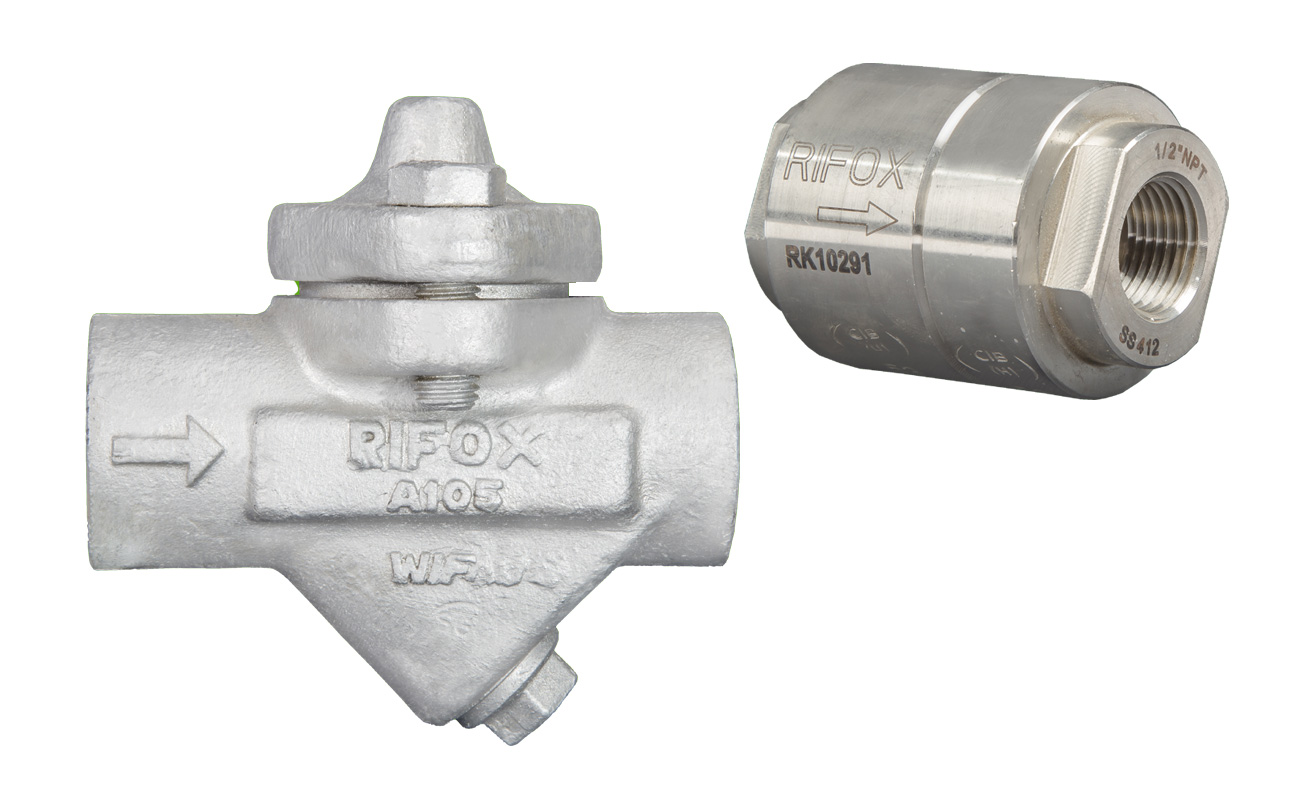
Thermostatic Steam Trap
Efficiently discharges condensate and air with temperature-sensitive automation for precise control
Submit your enquirySelect an option
Thermostatic steam traps leverage a temperature-sensitive element (such as a bimetallic strip or a liquid-filled capsule) that expands or contracts in response to changes in fluid temperature.
At lower temperatures (condensate and air), the element contracts, opening the trap valve to discharge. As live steam reaches the trap, the temperature rises, causing the element to expand and close the valve, preventing steam loss. This precise temperature-sensing capability makes them excellent for air venting during system start-up, significantly reducing warm-up times. They are versatile and can be designed to discharge condensate at a sub-cooled temperature, depending on the application.
Key Industries/Applications:
- Industries: Food & beverage, chemical, pharmaceutical, hospitals, laundries, and various process heating applications
- Applications: Steam tracing lines, unit heaters, sterilisers, jacketed vessels, plate heat exchangers, and any application where efficient air venting and condensate discharge close to saturation temperature (or with controlled sub-cooling) are beneficial

Technical data
- Product capacity / performance range: Available in various sizes and capacities to handle different condensate loads and operating pressures, it can be designed to discharge condensate at or below saturation temperature
- Compliance or standards: Designed and manufactured to relevant industry standards for steam trap performance and safety
- Design, flexibility or customisation:
- Operating elements: Bimetallic (can withstand superheat, robust), balanced pressure (quick response, compact, good air venting)
- Materials: Typically, available in stainless steel or forged steel for corrosion resistance and durability
- Connections: Screwed, flanged, or welded connections
- Adjustable sub-cooling: Some designs allow for adjustment of the discharge temperature below saturation
- Orientation: Some types can be installed in any orientation
Product features

Ease of installation & operational flexibility
Generally compact and can be installed in various orientations, offering good installation flexibility. Automatic operation provides reliable condensate removal without manual intervention, enhancing operational flexibility

Fuel flexibility & performance output
By efficiently removing air and condensate, these traps ensure that steam can fill the heat transfer surfaces quickly and completely, leading to optimal heat transfer and reduced steam consumption, thereby saving fuel

Innovative technology & smart controls
Self-modulating temperature-sensitive element automatically adjusts valve opening to discharge condensate while conserving steam, with excellent air venting capability

Structural strength, load handling & efficiency metrics
Robust design handles varying pressures and temperatures, minimising steam loss while effectively removing condensate and air to enhance overall system efficiency

Environmental Impact & Cost Saving
Minimizes live steam loss, directly reducing fuel consumption and associated greenhouse gas emissions. Improved system efficiency and reduced warm-up times translate into significant operational cost savings and a lower environmental footprint.